13/06/2008

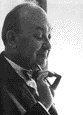
Alan Fletcher

The Design Museum is saddened at the news of the death of Alan Fletcher on 21 September 2006. Alan Fletcher had already made a very generous donation of his archive to the museum, and was very much involved in the planning of a retrospective exhibition here. The exhibition Alan Fletcher: fifty years of graphic work (and play), scheduled to open on 11 November 2006, will go ahead as planned, and will celebrate the remarkable life and work of this influential figure of British graphic design.
Synthesising the graphic traditions of Europe and North America to develop a spirited, witty and very personal visual style, ALAN FLETCHER is among the most influential figures in British graphic design as a founder of Fletcher/Forbes/Gill in the 1960s and Pentagram in the 1970s.
Designed to be opened at random, The Art of Looking Sideways, Alan Fletcher’s 2001 book, is an unfailing source of wit, elegance and inspiration. At over a thousand pages, it is a spectacular treatise on visual thinking, one that illustrates the designer’s sense of play and his broad frame of reference. [Ler mais...]

12/06/2008

Alan Fletcher _Graphis Magazine


A Few Words In Tribute To Alan Fletcher (1931-2006)

Wherever Alan is, I’m sure he will show them a few things that all those gone by have missed.
- Ed Benguiat

The news of Alan’s passing is sad news indeed. He will be missed. Hearing this new brought back a fond memory of Alan that I would like to share. In 1973, I had just graduated art school in Philadelphia and was planning a summer vacation in Europe. First stop: London. My friend and teacher Keith Godard suggested I visit Alan. Upon arrival I worried that I did not have the proper attire for such an important meeting. I frantically combed the stores in the Earl’s Court area looking for a “cheap” suit. When I arrived at Pentagram (or was it Crosby, Fletcher, Forbes back then) I waited nervously in the reception area, in my new suit (with bell-bottoms), wide paisley tie and shoulder length hair (think Austin Powers.) Soon after, Alan bounded down the stairs looking super cool and very casual in JEANS AND OPEN NECK SHIRT! I felt a tad foolish but relieved. As he was reviewing my portfolio, a fly landed in his glass of sparkling water. When he reached to take a sip I raised a cautionary finger. Looking into the glass he grunted some British expletive, grinned, and we continued our discussion. This was my very first professional job interview complete with job offer “should I decide to expatriate.” Although I saw him infrequently over the years, I never forgot that meeting. I’ve enjoyed his Monographica recently and think his Art of Looking Sideways is as incomparably brilliant as he was. My heartfelt condolences to his family.
-Ken Carbone

A lovely man
A brilliant mind
A visual genius
A giant among us.
His work will remind us
-Seymour Chwast

What a brilliant man, designer, artist, teacher and a total genius. Alan had such a powerful presence. Beware Wet Paint is still for me the best book about a designer, his thinking and work, only to be outdone, of course, by The Art of Looking Sideways, the ultimate book on design.
-Steff Geissbuhler

It’s always impossible to imagine the loss of anyone so filled with life and energy as Alan was—A beautiful man in every sense. Brilliant, generous, caring, charismatic and literate. In our generation there was no one like him. His contribution to our field will remain unsurpassed.
-Milton Glaser

I remember first meeting Alan in his London apartment. It seemed the quintessential designer’s flat: oak files, enamel signs and all. With his bald head, intense eyes, scar running down his cheek and tight jeans, he freaked me out. He looked like a villain from a James Bond movie. But he was, of course, a very sweet guy. His book, The Art of Looking Sideways, is a wonderful monument to leave behind, and it’s worth all he designer tomes published in the last decade. It’s a mainstay of my design and illustration teaching.
-Steven Guarnaccia

Call me naïve, but this is how I see it:
We have The Art of Looking Sideways, so therefore we have Mr. Fletcher. Forever. I’m afraid I don’t have any interesting anecdotes to share about the great man, having only met him fleetingly, twice.
But I have the book. And so, I have him. To consult, to listen to, to share and pass on to others. I am a great believer in “We are, ultimately, what we leave behind.” Graphic designers, if we do it right, leave behind a LOT of stuff. And Mr. Fletcher’s stuff is among the best. He now sits next to Paul Rand, Lester Beal, Alvin Lustig, Tibor Kalman, and many others, on my bookshelves. I consult them all the time. And I learn, constantly, from what they have to show and tell me.
-Chip Kidd

Alan was talented, witty, intelligent and courageous. He practiced his craft and life with singular and unaffected focus. He was a refreshing, outspoken straight shooter, leaving a legacy of great work that was uniquely his. Best of all, he had a caring and devoted family. Alan was challenging and just plain fun to be with, and I will sorely miss him.
-B. Martin Pedersen

We, as people- and design, as a profession, have lost a great and inspiring star. [Alan was] one of the wittiest and conceptual designers who ever lived.
-Deborah Sussman


To view Alan's obituary printed in the New York Times, please click on this link.


Alan was featured in Graphis Magazine issue # 297 May/June 1995 in an article by Ciaran McCabe, "Fletcher After Pentagram." 

11/06/2008

Jan Tschichold

Jan Tschichold, Leipzig
1902–1974
german type designer, calligrapher, typographer, author and teacher; einer der Wortführer der Bauhaus-Epoche
(most famous font: Sabon-Antiqua)

Classification of Types

According to DIN 16518 type-faces are divided up in the following categories: [Ver mais...]

07/06/2008

Paul Rand

A Brief Biography
PAUL RAND (BORN PERETZ ROSENBAUM, AUGUST 15, 1914 – NOVEMBER 26, 1996) was a well-known American graphic designer, best known for his corporate logo designs. Rand was educated at the Pratt Institute (1929-1932), the Parsons School of Design (1932-1933), and the Art Students League (1933-1934). He was one of the originators of the Swiss Style of graphic design. From 1956 to 1969, and beginning again in 1974, Rand taught design at Yale University in New Haven, Connecticut. Rand was inducted into the New York Art Directors Club Hall of Fame in 1972. He designed many posters and corporate identities, including the logos for IBM, UPS and ABC. Rand died of cancer in 1996.

06/06/2008

Cryptography / Criptografia

From Wikipedia, the free encyclopedia

Cryptography (or cryptology; derived from Greek κρύπτω krýpto "hidden" and the verb γράφω gráfo "to write" or λέγειν legein "to speak")[1] is the practice and study of hiding information. In modern times, cryptography is considered to be a branch of both mathematics and computer science, and is affiliated closely with information theorycomputer security, and engineering. Cryptography is used in applications present in technologically advanced societies; examples include the security of ATM cardscomputer passwords, and electronic commerce, which all depend on cryptography.

Criptografia (Do Grego kryptós, "escondido", e gráphein, "escrita") é o estudo dos princípios e técnicas pelas quais a informação pode ser transformada da sua forma original para outra ilegível, de forma que possa ser conhecida apenas por seu destinatário (detentor da "chave secreta"), o que a torna difícil de ser lida por alguém não autorizado. Assim sendo, só o receptor da mensagem pode ler a informação com facilidade. [Ler mais...]