15/02/2009

Text Treatment and the User Interface

By Tobias Komischke
Published: January 22, 2009


“Much of the information user interfaces present is textual. Therefore, we should not underestimate how the right text treatment can measurably improve user productivity and increase user satisfaction.”

Before graphic user interfaces, text was the primary means of both input and output defining human-computer interactions. Even today, much of the information user interfaces present is textual. Therefore, we should not underestimate how the right text treatment can measurably improve user productivity and increase user satisfaction. As new technologies become available—for example, larger monitors with higher resolutions—a good foundation of knowledge about effective text treatment can help designers create usable user interfaces for them more quickly.

Font Type

Content developers have hundreds of serif and sans serif fonts at their disposal. Serifs are small lines at the ends of the main strokes of characters. Serif fonts improve readability in continuous text, because the serifs help readers to structure and discriminate characters [1]. Times New Roman, for example, is a serif font, as Figure 1 shows. Typically, newspapers, magazines, and books use serif fonts.

Figure 1—Examples of serif and sans serif fonts
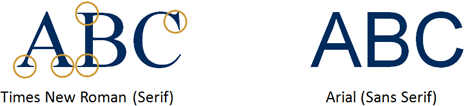
Serif and sans serif fonts


“On computer screens, sans serif fonts are preferable, because relatively low screen resolutions…make serif fonts look fuzzier, especially in small sizes.”

[Ler mais...] > UXmatters > 


References

[1] Wheeler, Susan G., and Gary S. Wheeler. TypeSense: Making Sense of Type on the Computer. Boston: International Thompson Computer Press, 1996.
[2] Dul, Jan, and Bernard Weerdmeester. Ergonomics for Beginners. Oxford: Taylor & Francis, 1993.
[3] Arditi, Aries, and Jianna Cho. “Letter case and text legibility in normal and low vision.” Vision Research: September, 2007.
[4] Watzmann, Suzanne. “Visual Design Principles for Usable Interfaces,” in The Human-Computer Interaction Handbook, ed. Andrew Sears and Julie A. Jacko. New York: Lawrence Erlbaum Associates, 2008.
[5] Byrne, Michael D. “Reading Vertical Text: Rotated vs. Marquee,” in Proceedings of the Human Factors and Ergonomics Society 46th Annual Meeting. Santa Monica, CA: Human Factors and Ergonomics Society, 2002.
[6] ISO 9241-3. Ergonomic requirements for office work with visual display terminals (VDTs)—Part 3: Visual display requirements. Geneva: International Organization for Standardization, 1992.
[6] Grandjean, Etienne. Ergonomics in Computerized Offices. New York: Taylor & Francis, 1986.
[8] Kroemer, Karl H.E., and Anne D. Kroemer. Office Ergonomics. New York: Taylor & Francis, 2001.

14/02/2009

Josef Müller-Brockmann

From Wikipedia, the free encyclopedia

Josef Müller-Brockmann, (May 9, 1914 – August 30, 1996), was a Swiss graphic designer and teacher. He studied architecture, design and history of art at both the University and Kunstgewerbeschule in Zurich. In 1936 he opened his Zurich studio specialising in graphic design, exhibition design and photography. From 1951 he produced concert posters for the Tonhalle in Zurich. In 1958 he became a founding editor of New Graphic Design along with R.P. Lohse, C. Vivarelli, and H. Neuburg. In 1966 he was appointed European design consultant to IBM. Müller-Brockman was author of the 1961 publications The Graphic Artist and his Design Problems, Grid Systems in Graphic Design where he advocates use of the grid for page structure, and the 1971 publications History of the Poster and A History of Visual Communication.

He is recognised for his simple designs and his clean use of typography, notably Akzidenz-Grotesk, shapes and colours which inspires many graphic designers in the 21st century. Many of his works can be found on the gallery Blanka. [Ler mais...]


Links:
A conversation with Josef Müller-Brockmann
by Yvonne Schwemer-Scheddin
eyemagazine.com

Helvetica _história, designers e imagens

Image Now Gallery

fifty years of helvetica 
05 -30.11.07

one: an exhibition in mono
03 - 17.11.06

forty-eight posters, Josef Müller-Brockmann
31.05 - 25.06.04


Outros links:
blanka.co.uk/50_years_of_helvetica

Paul Mijksenaar


Prof. Paul Mijksenaar is principal of Mijksenaar. The Dutch company with offices in Amsterdam and New York specialises in wayfinding. Its clients include Amsterdam Airport Schiphol, Port Authority of New York & New Jersey, New York City Transit, Dutch Railways, Rotterdam Metro and Amsterdam Metro but they work also for hospitals, museums, stadiums and any other venue that needs signing. Paul Mijksenaar teaches Visual Information Design at Delft University (Holland).


Left: Steven Spielberg, right: Paul Mijksenaar. Airport sign appears in the background.

Steven Spielberg Paul MijksenaarSignage on the setFlight-information panel

13/02/2009

Barbican Identity Guides

Stunning guideline book for Barbican by UK based firm North Design. The book features a section on how grids are applied to the identity.

Barbican Identity Guides > [ pdf ]


Barbican Identity Guides > [ Flickr ]


fonte: The Grid System > Antonio Carusone

12/02/2009

Berthold Types _OldFace

From Wikipedia, the free encyclopedia

Berthold Home

Berthold is a name long associated with type design. H. Berthold AG was one of the largest and most successful type foundries in the world for most of the modern typographic era. Established in 1858 by Hermann Berthold and based in Berlin, the company played a key role in the introduction of major new typefaces and was a successful player in the development of typesetting machines.

The H. Berthold foundry's most celebrated family of typefaces is arguably Akzidenz-Grotesk (released 1896), an early sans-serif which prefigured by half a century the release of enormously popular neo-grotesque faces such as Helvetica. In 1950, type designer Günter Gerhard Lange embarked upon a long affiliation with the company, for which he designed various original typefaces, including Concorde and Imago, and oversaw the foundry's revivals of classic faces such as Garamond, Caslon, Baskerville, and Bodoni.

Beset by financial troubles, H. Berthold AG ceased operations in 1993. Berthold Types Ltd. , a Chicago-based company, took over distribution of the Berthold digital type library and has released several new typefaces under the direction of Lange, who had retired in 1990, but now serves as artistic consultant to the new Berthold. [Ler mais...]