29/07/2007

The International Printing Museum

Background on the Printing Museum

The International Printing Museum in Southern California is a dynamic museum that takes one of the world's most significant collections of antique printing machinery and brings it to life through working demonstrations and theatre presentations. Since 1988, over 250,000 visitors have toured the museum, learning about the history of books and printing, great inventions and inventors that have changed our world. The Printing Museum has been recognized worldwide for its importance and size, and for the successful and creative approach it takes in interpreting the collection to a general audience.
The Museum was founded in 1988 by David Jacobson of Gutenberg Expositions and Ernest A. Lindner to house the Lindner Collection of Antique Printing Machinery. The collection has grown since then with significant donations and acquisitions, making the International Printing Museum the premier exhibit on printing history throughout the world.
From 1988 until 1997, the Printing Museum was located in the city of Buena Park. Following the acquisition of the Museum property by the California Department of Transportation in 1997, the collection was moved into storage while a new home was sought. The new public display opened in 1998 in the city of Carson, 20 minutes south of downtown Los Angeles. In February of 2003, the Board of Trustees for the International Printing Museum Foundation successfully raised the necessary down payment for the acquisition of the Museum property in Carson. [Ler mais...]


fonte: The International Printing Museum
...

27/07/2007

Da letra de mão à letra de forma:

percursos da caligrafia nas artes e nas técnicas
francisco g. cunha leão

Oficina tipográfica do séc. XVI; gravura sobre cobre de Théodor Galle, desenho de Jan van der Straet. Ilustra os vários cavaletes de tipo, com as folhas originais de que o oficial compositor e o revisor se ocupam. Ao fundo, o transporte do papel e a mesa com os atados de papel a imprimir; do lado esquerdo, um impressor fazendo a tintagem da forma no mármore da prensa; outro impressor accionando a alavanca da prensa; num estendal, várias folhas impressas, que, depois de secas, um aprendiz vai juntando em maços.

§ Assiste-se nesta época de fim de milénio à revolução que o computador e as «artes» da informática proporcionam: revolução porque implica qualitativa e quantitativamente uma alteração nos padrões tradicionais de cultura e civilização, com as respectivas incidências sociais, económicas ou religiosas. O seu alcance estará bem longe de ser medido ou avaliado. O que não acontece com semelhantes revoluções que sofreram aqueles que viveram os primórdios da tipografia de Quatrocentos, e ainda aqueles que há milénios transcreveram num suporte de terra endurecida, manualmente e com o auxílio de um estilete, os primeiros signos de transmissão do pensamento humano pela grafia, aos quais podemos fazer coincidir os grandes impérios da Antiguidade e respectivas civilizações; pelo que se pode afirmar que a invenção da escrita não é de forma alguma um processo concluído, quer nas suas múltiplas formas de expressão, quer nos seus efeitos. [Ler mais...]

20/07/2007

Hermann Zapf


Hermann Zapf, born in Nuremberg, Germany, in 1918 and now living in Darmstadt, taught himself calligraphy from the books of Rudolf Koch and Edward Johnston. He has had a distinguished career in type design and typography which stretches over fifty years. His Zapfino typeface, originally released in 1998, was an amazing success that has since worked its way into designs produced all around the world. Hermann Zapf’s artistic and technical masterpiece is both traditional and modern at the same time. Used with popular layout software applications, Zapfino can help create breathtakingly calligraphic layouts.

In 2003, Hermann Zapf reengineered his design, imbuing it with the new OpenType technology. Even though the resulting font, Zapfino Extra, has significantly more characters, OpenType technology makes the face drastically simpler to use.

Hermann Zapf is recognised as one of the world’s leading type designers and typographers, having designed Roman, Greek and Arabic faces. He has been made an Honorary Designer for Industry by the Royal Society of Arts and has won innumerable awards. He is an honorary member of over twenty-four societies across the globe and is also Honorary President of the Edward Johnston Foundation. Ler mais...

Edward Johnston Foundation

Honorary President Hermann Zapf

The Edward Johnston Foundation is dedicated to the promotion of public awareness of calligraphy, not only as an art form in its own right but also as the seed and reference point for many other lettering disciplines including modern typeface design. Based in Ditchling, Sussex the birthplace of the modern revival of calligraphy, the Foundation is working towards the establishment of a permanent centre for learning, research and education in the lettering arts.
Ler mais...


EDWARD JOHNSTON
(1872-1944)
by his teaching and practice almost single-handedly revived the art of formal penmanship which had lain moribund for four centuries. His major work Writing and Illuminating, and Lettering, first published in 1906 and in print continuously ever since, created a new interest in calligraphy and a new school of excellent scribes. The life he breathed into this ancient craft and its continuing tradition even in today’s hi-tech world can be ascribed to his re-discovery of the influence of tools, materials and methods. His researches were carried out with the understanding of the artist-craftsman, the scientist and the philosopher and this three-fold approach resulted in a profound insight - he fully grasped the root of formal writing and saw how all the branches grew from that root.

The epoch-making sans-serif alphabet he designed for the London Underground Railways changed the face of typography in the twentieth century whilst two of the most popular types of our day ‘Perpetua’ and ‘Gill Sans’ were by his great pupil
Eric Gill (1882-1940).

Johnston’s influence has been world-wide. As early as 1910 his pupil Anna Simons translated Writing and Illuminating, and Lettering into German and a tremendous interest was sparked off in that country. So much so that Sir William Rothenstein remarked on a visit to art schools on the continent, ‘in Germany in particular the name of Edward Johnston was known and honoured above that of any artist’.

The other great revival has been in the United States particularly since the 1970s where there has been a veritable explosion of interest both on a professional and amateur level. The annual lettering conferences held in important centres throughout the country are testimony to this rebirth. But, lest we forget Johnston’s pioneering work, we ought perhaps to remind ourselves of what Hermann Zapf has said recently of him,
“Nobody had such a lasting effect on the revival of contemporary writing as Edward Johnston. He paved the way for all lettering artists of the twentieth century and ultimately they owe their success to him”. Hermann Zapf
Ler mais...

17/07/2007

The Crystal Goblet

by Beatrice Warde

Excerpt from a Lecture to the British Typographers’ Guild

Imagine that you have before you a flagon of wine. You may choose your own favorite vintage for this imaginary demonstration, so that it be a deep shimmering crimson in color. You have two goblets before you. One is of solid gold, wrought in the most exquisite patterns. The other is of crystal-clear glass, thin as a bubble, and as transparent. Pour and drink; and according to your choice of goblet, I shall know whether or not you are a connoisseur of wine. For if you have no feelings about wine one way or the other, you will want the sensation of drinking the stuff out of a vessel that may have cost thousands of pounds; but if you are a member of that vanishing tribe, the amateurs of fine vintages, you will choose the crystal, because everything about it is calculated to reveal rather than to hide the beautiful thing which it was meant to contain.

Bear with me in this long-winded and fragrant metaphor; for you will find that almost all the virtues of the perfect wine-glass have a parallel in typography. There is the long, thin stem that obviates fingerprints on the bowl. Why? Because no cloud must come between your eyes and the fiery hearth of the liquid. Are not the margins on book pages similarly meant to obviate the necessity of fingering the type-pages? Again: The glass is colorless or at the most only faintly tinged in the bowl, because the connoisseur judges wine partly by its color and is impatient of anything that alters it. There are a thousand mannerisms in typography that are as impudent and arbitrary as putting port in tumblers of red or green glass! When a goblet has a base that looks too small for security, it does not matter how cleverly it is weighted; you feel nervous lest it should tip over. There are ways of setting lines of type which may work well enough, and yet keep the reader subconsciously worried by the fear of "doubling" lines, reading three words as one, and so forth.

Printing demands a humility of mind, for the lack of which many of the fine arts are even now floundering in self-conscious and maudlin experiments. There is nothing simple or dull in achieving the transparent page. Vulgar ostentation is twice as easy as discipline. When you realise that ugly typography never effaces itself, you will be able to capture beauty as the wise men capture happiness by aiming at something else. The “stunt typographer” learns the fickleness of rich men who hate to read. Not for them are long breaths held over serif and kern, they will not appreciate your splitting of hair-spaces. Nobody (save the other craftsmen) will appreciate half your skill. But you may spend endless years of happy experiment in devising that crystalline goblet which is worthy to hold the vintage of the human mind.

http://www.typographia.org/

Beatrice Warde


Beatrice Warde (1900-69). American typographer, writer and scholar who spent much of her working life in England. Educated at Barnard College, Columbia, where she developed an interest in calligraphy and letterforms. From 1921-25 Beatrice worked as assistant librarian with the American Type Founders Company, pursuing her research into typefaces and the history of printing. In 1925, after marrying the type designer Frederic Warde, she moved to Europe, subsequently working for the Fleuron, then edited by Stanley Morison.

[Ler mais...] > More about Beatrice Warde

Beatrice L. Warde_The typographer, writer...

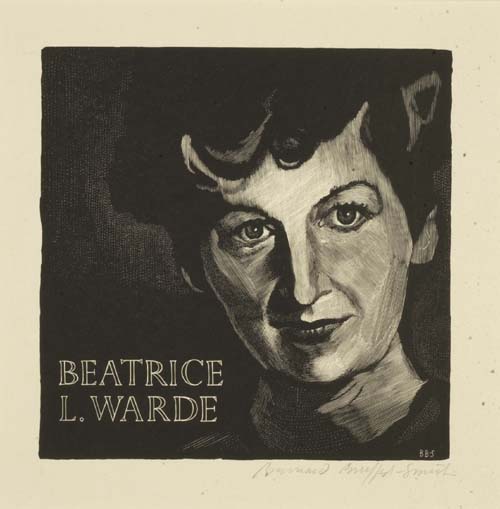
Beatrice L. Warde, American, 1900-1969

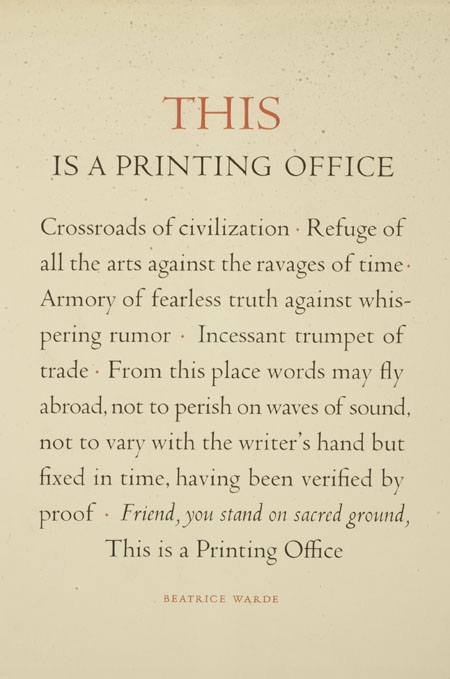
The typographer, writer, and historian of printing Beatrice Warde was educated at Barnard College, Columbia, where she developed an interest in calligraphy and letterforms. From 1921-1925 Warde was the assistant librarian at the American Type Founders Company, pursuing her research into typefaces and the history of printing. In 1925 she married the book and type designer Frederic Warde, Director of Printing at the Princeton University Press. The couple moved to Europe, where Beatrice worked on The Fleuron: A Journal of Typography, then edited by Stanley Morison. Her reputation was established by an article she published in the 1926 issue The Fleuron, written under the pseudonym "Paul Beaujon," which traced types mistakenly attributed to Garamond back to Jean Jannon of Sedan. In 1927 she became editor of The Monotype Recorder, in London. Beatrice Warde was a believer in the power of the printed word to defend freedom, and she designed and printed her famous manifesto, This Is A Printing Office, in 1932, using Eric Gill's Perpetua typeface. She rejected the avant-garde in typography, believing that classical forms provided a "clearly polished window" through which ideas could be communicated.

The Crystal Goblet: Sixteen Essays on Typography (1955) is an anthology of her writings.

This Is a Printing Office, by Beatrice Warde, 1932. Broadside.
"Set in Centaur and Arrighi types by Westcott & Thomson and reprinted for the Type Directors Club of New York on the occasion of their dinner honoring Mrs. Warde on April 28, 1950"
Graphic Arts Division


Portrait of Beatrice L. Warde, by Bernard Brussel-Smith. 1950. Wood engraving on Basingwerk Parchment. Signed with initials in block and in pencil on sheet, lower right.
Graphic Arts Division


Other works in the exhibition:

The Fleuron: A Journal of Typography, Cambridge, England: At the University Press; New York: Doubleday Doran, 1923-1930.
No. VI, 1928, containing an article by Paul Beaujon (pseudonym of Beatrice Warde), "On Decorative Printing in America" Limited edition on hand-made Batchelor Kelmscott paper. Binding and end papers for no. 6 designed by Lucian Bernhard, Berlin.
Graphic Arts Division
Beatrice/Paul/Warde/Beaujon: Quotations from the Writings of Beatrice Warde, Maple Shade, New Jersey: Printed by John Anderson, The Pickering Press, 1953.
Graphic Arts Division
The Crystal Goblet: Sixteen Essays on Typography, by Beatrice Warde. London: Sylvan Press, 1955.
Graphic Arts Division

Glossaire typographique et linguistique


Bem-vindos ao Babel Site, um projeto de parceria entre a Alis Technologies e a Internet Society visando internacionalizar a Internet.
(...) Também oferecemos um GLOSSÁRIO de termos associados às línguas e suas formas tipográficas, incluindo vários documentos sobre países de língua francesa (estes últimos disponíveis apenas neste idioma)...

09/07/2007

An Interview with Matthew Carter

One of this century´s foremost type designers and co-founders of Bitstream, (America´s first digital type foundry), Matthew Carter shares his insight and experience regarding 20th century typography in America, ATF, Morris Fuller Benton, Linotype, ITC, Swiss International type design, current typographic movements and more.

Today Carter is the principal of Carter & Cone Type in Cambridge, Massachusetts. One of this century's foremost type designers and co-founders of Bitstream, (America´s first digital type foundry), Matthew Carter shares his insight and experience regarding 20th century typography in America, ATF, Morris Fuller Benton, Linotype, ITC, Swiss International type design, current typographic movements and more. Today Carter is the principal of Carter & Cone Type in Cambridge, Massachusetts. One of this century´s foremost type designers and co-founders of Bitstream, (America's first digital type foundry). [Ler mais...]