Ambigram? Ambi-what?
by Nikita Prokhorov
It’s definitely not a medical procedure, despite ending in ‘gram.’ You will not find a definition of ambigram in any dictionary. The only way to understand the true essence of an ambigram is to read this blog, twenty-four hours a day, seven days a week, nonstop, ignoring any other commitments and responsibilities in your life. Sounds like a good idea, right? [Ler mais...]
31/07/2008
30/07/2008
Sebenta de Design
A Sebenta de Design pretende ser um local virtual de saberes sobre design. Escrita em sistema colaborativo por voluntários, é publicada na internet sob a forma de um wiki, para que qualquer pessoa, a qualquer momento, possa editar os conteúdos disponíveis ou acrescentar novos. Paralelamente à estrutura de manual, visa oferecer um glossário de termos técnicos de design, um directório de designers, tipógrafos e autores de textos sobre design. [Ler mais...]


29/07/2008
Sibylle Hagmann _Kontour
Kontour is a design studio in Houston, Texas. It was founded by Sibylle Hagmann in 2000. It is committed to non-profit projects. The client list includes the MFAH, Museum of Fine Arts Houston; the Dallas Museum of Art, Dallas; the Fisher Gallery of the University of Southern California, Los Angeles, among others.
Most type design project are client independently initiated, but feed often back into client driven assignments. [Ler mais...]
Odile was among the awarded projects in the 2006 Swiss Federal Design Grants, "Selected — Awarded", of the Swiss Federal Office of Culture. [Download pdf specimen (620 kb]
The Cholla™ type family was published in Experimental Typography, edited by Teal Triggs, Thames & Hudson, 2003.
Kontour was commissioned to submit a proposal for a new typeface design for use in the Twin Cities Design Celebration (TCDC) in Minneapolis/St.Paul in 2003.


Most type design project are client independently initiated, but feed often back into client driven assignments. [Ler mais...]
Odile was among the awarded projects in the 2006 Swiss Federal Design Grants, "Selected — Awarded", of the Swiss Federal Office of Culture. [Download pdf specimen (620 kb]
The Cholla™ type family was published in Experimental Typography, edited by Teal Triggs, Thames & Hudson, 2003.
Kontour was commissioned to submit a proposal for a new typeface design for use in the Twin Cities Design Celebration (TCDC) in Minneapolis/St.Paul in 2003.
28/07/2008
Rick Poynor
Rick Poynor founded Eye magazine in London in 1990, edited it for seven years and is now its resident columnist. He writes the "Observer" column for Print magazine and he has written about design, media and visual culture for Blueprint, Icon, Frieze, Domus, I.D., Metropolis, Harvard Design Magazine, Adbusters, The Guardian, The Financial Times, and many other publications.
His books include More Dark Than Shark (1986), a study of Brian Eno's early songs, Typography Now: The Next Wave (1991), and Typographica (2001). He is the author of two collections of essays,Design Without Boundaries (1998) and Obey the Giant: Life in the Image World (2001). No More Rules, a critical study of graphic design and postmodernism, appeared in 2003.
Poynor studied the history of art at Manchester University and gained an MPhil in design history from the Royal College of Art, London. He has been a visiting professor at the RCA and a tutor at the Jan van Eyck Akademie in Maastricht, and he lectures widely on design matters in Europe, the United States and Australia. He is guest curator of the exhibition "Communicate: Independent British Graphic Design since the Sixties", which opened at the Barbican Centre, London in September 2004 and is touring in China through 2005.
His books include More Dark Than Shark (1986), a study of Brian Eno's early songs, Typography Now: The Next Wave (1991), and Typographica (2001). He is the author of two collections of essays,Design Without Boundaries (1998) and Obey the Giant: Life in the Image World (2001). No More Rules, a critical study of graphic design and postmodernism, appeared in 2003.
Poynor studied the history of art at Manchester University and gained an MPhil in design history from the Royal College of Art, London. He has been a visiting professor at the RCA and a tutor at the Jan van Eyck Akademie in Maastricht, and he lectures widely on design matters in Europe, the United States and Australia. He is guest curator of the exhibition "Communicate: Independent British Graphic Design since the Sixties", which opened at the Barbican Centre, London in September 2004 and is touring in China through 2005.
Brilliant, Engaging, But Modest It’s Not
 Stefan Sagmeister’s latest book may reveal as much about the state of graphic design as it does about its compelling author.
By Rick Poynor
Posted June 18, 2008
Stefan Sagmeister is one of the best known and most popular graphic designers working today. He hasn’t yet reached the level of international renown and influence on design that David Carson achieved in the 1990s, but Sagmeister’s fame is of a different kind. His main contribution has been his emphasis on the handmade, in reaction to the slickness and unreality of so much digital design, and his willingness to treat any kind of material as a suitable component. Still, there are many equally accomplished designers at work around the world today who are nowhere near as famous. The crucial factor in Sagmeister’s success is the way that he publicly performs the role of designer, just as Jeff Koons and Damien Hirst publicly perform the role of artist. Even before Sagmeister made the unlikely though hugely effective career move of cutting the details of a lecture into his own flesh for a poster, his presence and personality was a feature of his work. Since that painful moment nine years ago, his most highly publicized and emblematic projects have tended to be about himself.
It’s there again in the title of his latest book, Things I Have Learned in My Life So Far, which takes it for granted that his fans won’t be able to resist a proposition that sounds like a fusion of autobiography and self-help manual. The project—a collection of loose pamphlets in a slipcase to be read in any order—is based on 20 personal maxims that Sagmeister has been able to interpret in the last six years in the form of magazine spreads, billboards, light boxes, annual reports, and fashion brochures. The cover is an image of his own face die-cut with apertures that encourage you to play with and pattern his features in different ways by shuffling the pamphlets. It’s a typically brilliant and engaging piece of design, but it sure ain’t modest. [Ler mais...]
Things I Have Learned In My Life So Far, BY Stefan Sagmeister
ESSAYS by Steven Heller, Daniel Nettle, and Nancy Spector
Courtesy Abrams
Courtesy Abrams
...
27/07/2008
James Craig _Designingwithtype.com
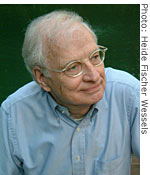
James Craig is responsible for the creation of this Web site as a means of enhancing the study of typography. Mr. Craig, a well-known author of books on graphic design, was born in Montreal, Canada. He studied fine arts in Montreal and Paris before immigrating to the United States. He received his BFA from The Cooper Union and his MFA from Yale University. Now semi-retired, Mr. Craig was the Design Director for Watson-Guptill Publications and is a member of the New York Art Directors Club, Association Typographique Internationale (ATypI), Type Directors Club (TDC), Typophiles, and a past member of the American Institute of Graphic Arts (AIGA). At present he teaches typography and design at The Cooper Union and lectures widely.
Designingwithtype.com é um site dedicado à arte e à apreciação da tipografia. Ele oferece recurso tipográfico singular para estudantes, educadores e profissionais, apresentando o talento pelo mundo.
Criado originalmente por James Craig como um suplemento para seu livro Designing with Type: A Basic Course in Typography especificamente
para seus estudantes da Cooper Union, o site cresceu, passando a incluir contribuições apresentadas por colegas educadores e designers, e com isso envolver um público maior.
Projetos apresenta exercícios tipográficos selecionados do Designing with Type, juntamente com diversos projetos apresentados por alguns dos principais designers do mundo.
Tipos mostra uma seleção de tipos favoritos, fornecida pelos colaboradores dos projetos, assim como projetos acadêmicos de tipos, type foundries, e downloads gratuitos.
Recursos traz resenhas dos livros de James Craig e apresenta um amplo panorama dos mais influentes livros, revistas, organizações, sites e as principais escolas de design do mundo.
Fórum Aberto recebe comentários e oferece artigos, citações, linhas do tempo, e demais itens do interesse de designers gráficos e educadores.
Equipe de Design apresenta os principais responsáveis por este site.
26/07/2008
Different Strokes _printmag.com
| Different Strokes |
 KARSTEN SCHMIDT: A still from "New Shoots," a 12-part series of documentary films by disabled directors. Creative direction: This Is Real Art; client: Maverick TV/Channel 4. Also: Read a behind-the-scenes account how Schmidt created this month's cover art. How a small but growing number of “creative programmers” are changing the face of type. By Emily King Every day, Karsten Schmidt’s London flat is home to both biological and digital growth. He tends to the marigolds and freesia on the balcony as he waits for tendrils of code to render in software such as Processing and Sunflow—the ultimate 21st-century jungle. Schmidt, a self-described “creative programmer,” is a member of the technological cognoscenti who contribute to Processing, an open-source programming language for image-making and animation initiated by MIT Media Lab graduates Ben Fry and Casey Reas. Just as gardening is a matter of planting and watering, rather than actually crafting flowers and leaves, Schmidt says design should take place at a more profound level than that of layout. He says the design community has allowed available software to define what’s possible aesthetically, that “the the vast majority of the creative industry is not making its own tools anymore.” As if proving his point, Schmidt has been writing his own code to build letterforms that can, among other things, sprout leaves just like his houseplants. Last year, he designed a title sequence for “New Shoots,” a series of films shot by disabled directors for the U.K.-based Channel 4. In a matter of seconds, a topiary version of the title grows into a thick hedge, like a Chia Pet on growth hormones. The process involves millions of particles attaching themselves to the outline of the Channel 4 house font, each controlled by a combination of factors described by programmers in terms such as stickiness, snap distance, density, chance of attachment, and alignment strength. Schmidt, who also goes by the name Toxi, argues that the design product isn’t what’s seen onscreen, but rather the unseen lines of code that determine the eventual output, a program that could be applied to any other line-based shape. “Design is the output of the design machine,” he declares.  PETER CHO: A still from Takeluma (2005), an invented writing system in which letterforms explore the way speech sounds can give rise to a variety of visual responses. As dynamic typography becomes a part of everyday commercial design, creative programmers such as Schmidt are pushing the limits of new technology while ensuring their work has a solid raison d’ être. Not only can their type design occupy two and three dimensions—it can take time into account as well, morphing, evolving, or growing to the point where movement itself is part of the design. But does movement enhance communication? Need every sentence spin? Dancing type may have a firm place in the imagination, but its place in the real world remains less certain. “Just because you can,” warns Schmidt, “doesn’t mean you should.” The field of kinetic type is not, nor has it ever been, solely digital. Writing a word with a handheld light source and capturing it on film—or creating letters in the sky with the vapor trail of a plane—are methods that have been around for decades. More recently, the digital and non-digital realms have come together in the form of Josh Nimoy’s Robotic Typography (2004), a letter-making machine that responds to keyboard commands; last year, Peter Bilak introduced DanceWriter, a program that allows users to type a phrase and see it performed onscreen by a member of the Nederlands Dans Theater. It was the introduction of PostScript, however, in the mid-’80s, that changed the design field. It forced type designers to realize that they were not working with fixed outlines of letterforms, but rather with the code that defines them. This understanding remains the locus of experimental practice.  HUDSON-POWELL: Screenshot from Responsive Type, 2007. Earlier this year, Erik Spiekermann, the founder of the type purveyor FontShop and an early advocate of the potential of PostScript’s capabilities, collaborated on a typeface with Erik van Blokland, one half of the Dutch design and programming duo LettError. In combination with another program called RoundingUFO, a specific corner-rounding application created by Belgian designer and programmer Frederik Berlaen, they produced a rounded version of Spiekermann’s Unit typeface usingSuperpolator, a tool that generates forms for animation or print. Berlaen’s code generated different rounded versions of Unit, which were then fed into Superpolator in order to make proofs and animations that Spiekermann used to easily determine the right curvatures. Just what type designers should do with these new technological possibilities is still being worked out. The wide range of ambitions and interests that drives kinetic type—programming, type design, rendering, and animation—can appear contradictory. For example, some designers, such as Processing’s Fry and Reas, are fascinated with generative processes, in which they create code, feed in data, and stand back to see what emerges. Fry, in particular, is known for visualizing unwieldy masses of biological information in a way that could only be enabled by digital technology. “I think the real reason we’re seeing so much generative work is because the computational medium makes it possible to think this way,” he says.  JÜRG LEHNI: Hektor's motion paths as calculated by the controlling software. Whereas Fry and Reas use code to generate unpredictable forms, others, such as Jürg Lehni, prefer to craft digital tools to better achieve predetermined ends. After building the interactive type specimens Lego Font Creator and Rubik Maker for Lineto.com, Lehni createdScriptographer, a plug-in for Adobe Illustrator that, though not strictly a typographic tool, allows users to extend Illustrator’s functionality through a simple scripting language. Lehni describes this as opening the “black box” of proprietary software, helping designers take control of their materials. This tool manipulation ethos may seem to be in opposition to the generative programming approach, but the small and highly self-selective Scriptographer users still enjoy accidental outcomes and unpredicted events. Chance drips and malfunctions are integral to the performance of Hektor, Lehni’s celebrated Scriptographer-powered, computer-driven, “spray-paint output device.” Likewise, the Dutch “process designer” Jonathan Puckeyshies away from the idea of “rigid form.” Puckey, who has created various Scriptographer-derived lettering tools, puts typographic manipulation into the hands of designers, yet believes that “the final product should be elastic.” The overriding issue for most designers exploring this realm is clarity and quality of expression. Peter Cho, another product of MIT’s Media Lab, describes his guiding concern as “how motion can affect the message in unexpected ways, making it more complex or even counteracting it.” In 2005, he took the notion of kinetic type into the realm of abstraction with the invention of Takeluma, a writing system based on the sound of speech. Although not readable in any conventional sense, this scheme raises the possibility that kineticism might convey meaning independent of fixed form, reopening an investigation into the long-held ideal of a universal language. “It reinvents type,” says Reas, Cho’s former classmate. At the very least, the animated movement suggests the explosiveness and ephemeral nature of speech. Cho’s investigations have trickled down into mainstream commercial design. A 2005 TV ad for the Audi A6, by French film company Pleix, shows a carexploding into multiple abstract forms, which then flow through an empty cityscape, pausing to spell the company slogan “Vorsprung Durch Technik” (Advancement Through Technology). Made for an international market, the smooth dynamism of the phrase’s execution is even more eloquent than a literal translation. Working along similar lines, Matthias Hillner has been exploring the transition between abstraction and legibility in space and time. He believes that much of the commercial work in this field, such as title sequences and “brand stings”—forms built in Flash that swoosh across the screen before coalescing into a logo—betray the medium’s promise. “Too often it’s a gimmick,” he complains. “They don’t challenge the viewer or explore the potential.” In 2004, Hillner proposed a fragmented signage system using his Wireframe typeface for the outer-London borough of Croydon. He abandoned that scheme because it would be “inappropriate to add visual stimulants to an environment which in itself appears overly dense.” Yet he still believes virtual typography has a role to play in busy, unpredictable environments.  BEN FRY: Still from Tendril (2000), a web browser that constructs typographic sculptures from the text content of web pages. Although print and screen remain separate fields, the need for typefaces that move seamlessly between the two media is growing. The London-based firmHudson-Powell is working on an ambitious, would-be standard software that would create dynamic screen-based type. “We want to make a typeface that works as well spinning on a digital billboard as it does in a printed brochure,” says Luke Powell. During the past three years, the studio has been collaborating with the Processing community on Responsive Type, a set of Futura-based letterforms. Eventually, the group hopes to have an open-source program that can work with more complex typographic configurations. Meanwhile, Schmidt is working on a program that will create covers for a new series of books being launched this summer by the publisher Faber and Faber. Although each cover is technically the same, no two are alike. The design is merely a set of instructions. The process is similar to Hella Jongerius’s B-set, porcelain plates baked in a kiln that is too hot in traditional terms, turning each into an irregular individual. Ironically, perhaps the biggest problem facing the field of kinetic typography is a tendency to repeat the experiments of the past. Sequences made in sophisticated software programs often look suspiciously like vamped-up versions of ’50s film titles; forays into responsive type often replicate, in seeming ignorance, the experiments—Tobias Frere-Jones’s self-destructing Reactor font, or Paul Elliman’s photo-booth-based Alphabet—of the early digital days. But what creators of kinetic typography want most is more time. Perhaps, before this work can become a more meaningful part of the graphic vocabulary, the most pressing need is for clients who will allow these creative programmers the chance to sort out the difference between what can, and what should, be done. This article appears in the August 2008 issue.Emily King is a London-based design historian. She divides her time between writing and curating. |
25/07/2008
22/07/2008
Peter Gabor

Né à Budapest
Etudes à Paris
Typo, design, socio et photo.• Graphiste & typographe freelance• Créateur de caractères• Consultant en identité d’entreprise• Conférencier• Enseignant la typo et le graphismeUn signe, une forme, des couleurs, du sens : «le style n’est pas une danse, c’est une démarche» (Jean Cocteau). Le signe et son organisation sont mon métier.
Typo, design, socio et photo.• Graphiste & typographe freelance• Créateur de caractères• Consultant en identité d’entreprise• Conférencier• Enseignant la typo et le graphismeUn signe, une forme, des couleurs, du sens : «le style n’est pas une danse, c’est une démarche» (Jean Cocteau). Le signe et son organisation sont mon métier.
15/07/2008
Three Typefaces for Mathematics
Written by: Daniel Rhatigan, 2007
Three typefaces for mathematics
The development of Times 4-line Mathematics Series 569, AMS Euler, and Cambria Math
Three typefaces for mathematics
The development of Times 4-line Mathematics Series 569, AMS Euler, and Cambria Math
Abstract
This paper examines the issues involved in the design of typefaces for mathematics. After a brief discussion of some of the typographic and technical requirements of maths composition, three case studies in the development of maths types are presented: Times 4-line Mathematics Series 569, a complement to the Times New Roman text types as set with Monotype equipment; AMS Euler, an experimental design intended to contrast against non-mathematical typefaces set with TEX; and Cambria Math, designed in concert with a new text face to take advantage of new Microsoft solutions for screen display and maths composition.
In all three cases, the typefaces were created to show the capabilities
of new technological solutions for setting maths. The technical advances inherent in each font are shown to be as central to its function as its visual characteristics.
By looking at each typeface and technology in turn, and then comparing and contrasting the issues that are addressed in each case, it becomes apparent that even though certain challenges are overcome with technical advances, the need to consider the specific behaviours of type in a maths setting remains constant.
Format: PDF 2.86MB
[Ler mais...] > TypeCulture
This paper examines the issues involved in the design of typefaces for mathematics. After a brief discussion of some of the typographic and technical requirements of maths composition, three case studies in the development of maths types are presented: Times 4-line Mathematics Series 569, a complement to the Times New Roman text types as set with Monotype equipment; AMS Euler, an experimental design intended to contrast against non-mathematical typefaces set with TEX; and Cambria Math, designed in concert with a new text face to take advantage of new Microsoft solutions for screen display and maths composition.
In all three cases, the typefaces were created to show the capabilities
of new technological solutions for setting maths. The technical advances inherent in each font are shown to be as central to its function as its visual characteristics.
By looking at each typeface and technology in turn, and then comparing and contrasting the issues that are addressed in each case, it becomes apparent that even though certain challenges are overcome with technical advances, the need to consider the specific behaviours of type in a maths setting remains constant.
Format: PDF 2.86MB
[Ler mais...] > TypeCulture
Subscrever:
Mensagens (Atom)